

Why Your Heat Pump Is Freezing Up
Thin frost that clears on its own is normal. A block of ice is a fault. Here is how to tell which one you have.
- NM CID License #413436
- 24 Google reviews
- Led by Dominic Montoya, over 20 years in the trade
- Free written estimates
By Dominic Montoya, Owner of Red Wrench Company. Published , updated .
A heat pump freezing up in winter is normal up to a point. Light frost forms on the outdoor coil on cold, damp mornings, and a defrost cycle melts it off. Thick ice that stays or covers the fan is a fault. Shut the system off, use your backup heat if you have it, and call Red Wrench Company.
Normal Frost or a Heat Pump Freezing Up?
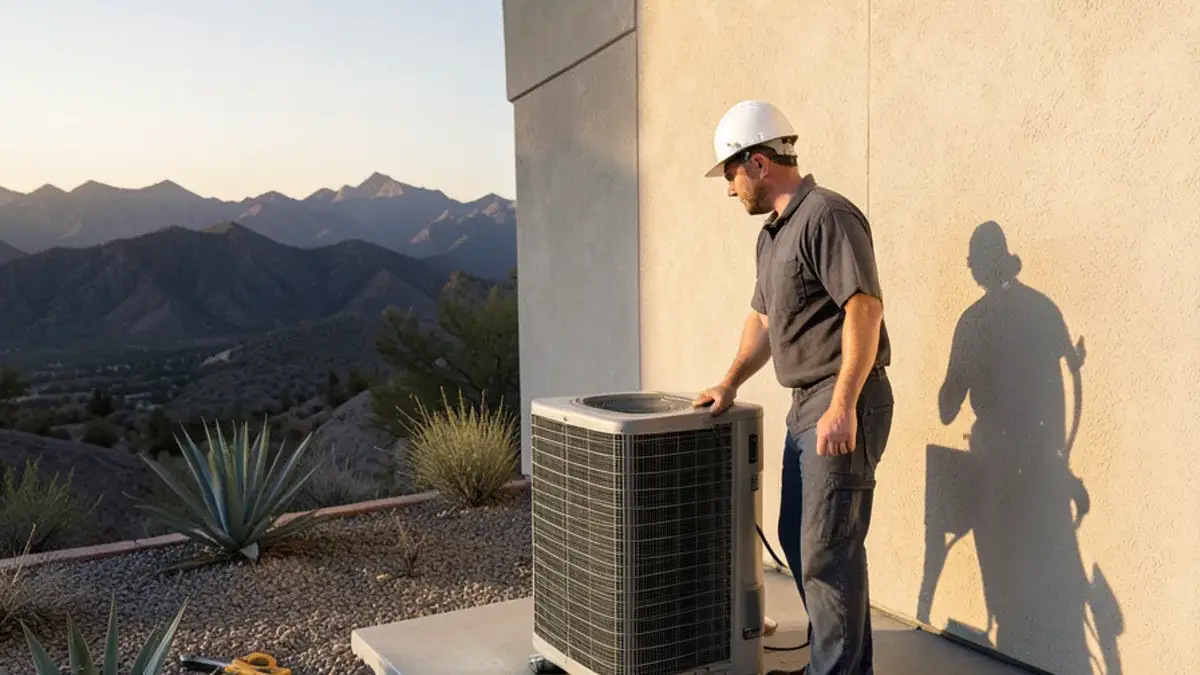
Look at the outdoor unit and judge by the thickness and whether it clears. A thin white coat on the coil is part of normal winter running. Solid ice is not.
| What you see | Normal or a fault? | What to do |
|---|---|---|
| Thin frost on the coil, fins still visible | Normal | Leave it alone |
| Steam rising and the fan stopped briefly | Normal defrost | Wait for it to finish |
| Cool air indoors during that time | Normal, unless it lasts | Wait, then recheck |
| Thick ice hiding the fins | Fault | Shut it off and call |
| Ice on the top or around the fan | Fault | Shut it off and call |
| Ice sheet under a roof drip or canale | Water problem | Redirect the water, then call |
| Frost that never clears through the day | Fault | Shut it off and call |
During defrost the system briefly reverses, sending heat to the outdoor coil. The fan usually stops, and you may hear a whoosh and see steam. People often mistake that steam for smoke. Defrost cycles usually finish within minutes, though the timing varies by model.
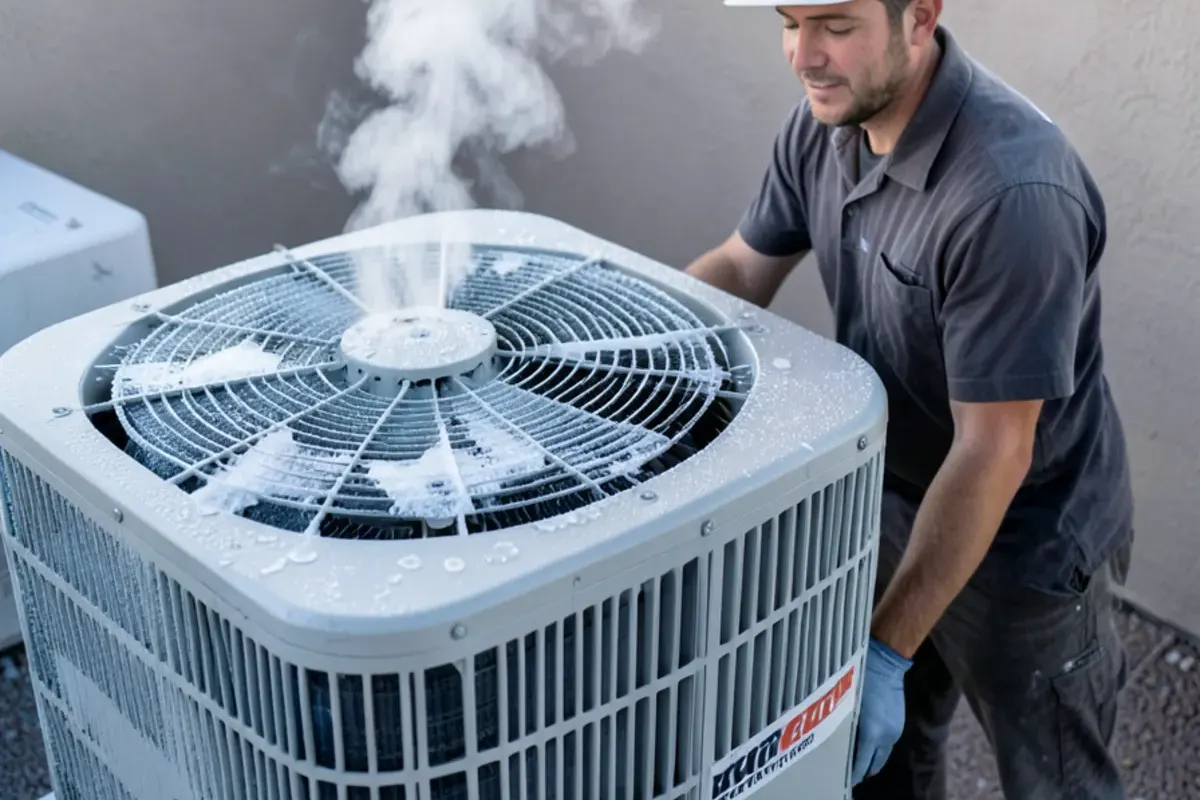
Why Does a Heat Pump Freeze Up Here?
Winter here is the setup. Albuquerque averages about 113 freezing nights a year, per BestPlaces, and many nights hover around freezing, when a heat pump collects frost. Six things turn that normal frost into a real problem.
- Failed defrost control. A bad board, sensor or relay means defrost never starts, or it stops too early.
- Weak airflow outside. Dust packed into the coil, or a failing fan motor, lets the coil get too cold.
- Low refrigerant. A leak drops the coil temperature, and frost builds faster. A low charge always means a leak.
- Roof runoff. Water dripping from a canale, gutter or flat roof edge can freeze on top of the unit. Flat roofs and canales make this a real risk here.
- Snow or ground ice. A unit sitting too low can block its own drain, and meltwater freezes around the base.
- Low airflow inside. A clogged filter cuts the heat moving through the system and keeps it from running normally.
Summer freezing is its own thing. If ice shows up on the indoor coil or refrigerant lines while cooling, the usual cause is low airflow or low charge, as on any AC.
Placement decides how often causes 4 and 5 show up. PNNL's Building America guide says to install outdoor units well above snow height and away from spots where meltwater or sliding snow and ice can land, which favors a gable end over an eave. On a flat-roofed house, that means staying clear of every canale.
Neighborhood matters too. National Weather Service Albuquerque lists 187 days between freezes in the South Valley against 210 at the Sunport, so a South Valley unit can see more frost mornings than the airport figures imply.
What to Do Right Now
Take these steps in order. None of them requires tools.
- Shut the heat pump off at the thermostat if the ice is thick. If yours has an emergency heat setting, switch to it. Electric backup heat costs more to run, so use it as a bridge.
- Change the filter and check the supply vents are open.
- Clear snow from around the cabinet. Keep about two feet of space.
- Look up for the water source if the ice is on top.
Never chip at the ice. Coil fins bend easily, and a sharp tool can puncture a refrigerant line, turning a control repair into a leak. Do not pour boiling water on the unit either. Thermal shock and more ice at the base are both likely.
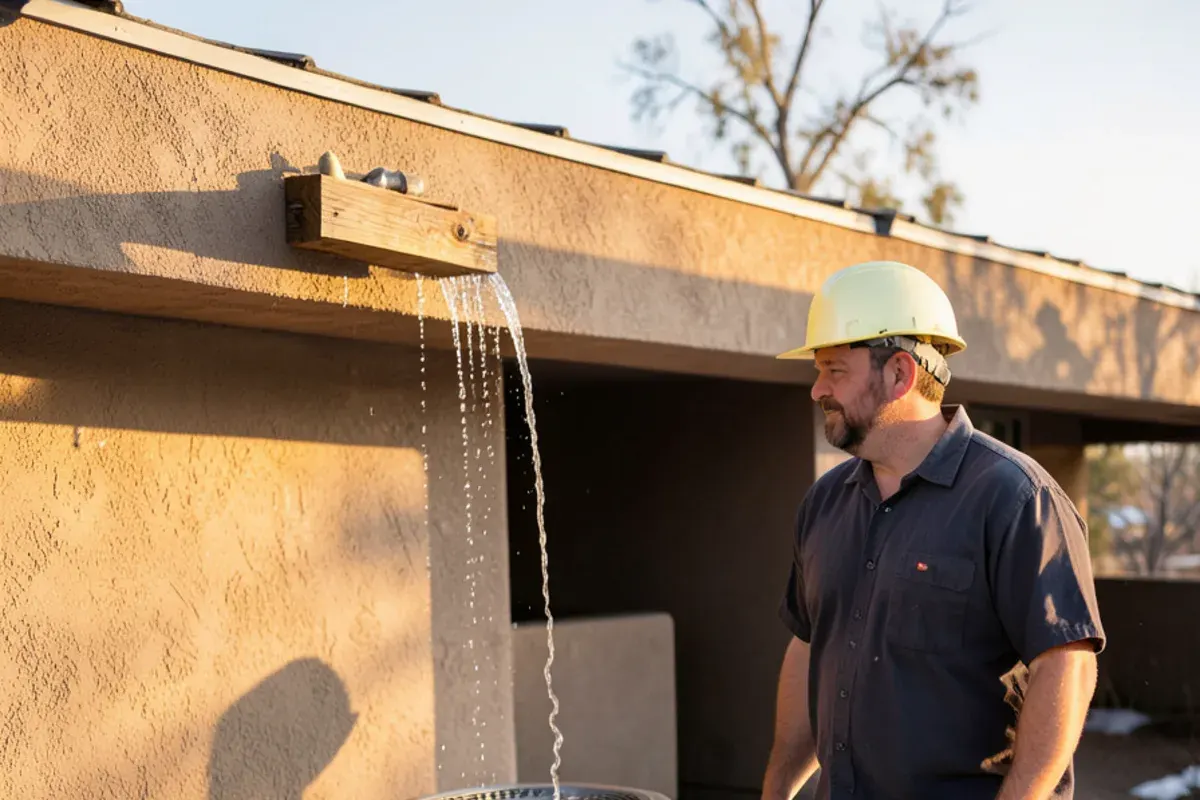
What We Tell Customers With a Frozen Outdoor Unit
These rules are simple, and they protect the most expensive part of the system.
Do not keep running a solid block of ice. A frozen coil blocks airflow, and the compressor keeps working against it. Shutting off early is cheaper than a compressor.
Watch the bill as well as the coil. A heat pump that cannot defrost often leans on electric backup heat. A sudden jump in the power bill can be the first sign.
Fix the water before you fix the system. If runoff is the cause, a splash guard or a change in drainage can matter more than any part.
Fix the leak if charge is the cause. EPA says owners can keep repairing existing systems, though it warns that refrigerant availability may lessen as HFCs phase down.
ENERGY STAR's maintenance list also covers refrigerant levels and clean coils, which is why the fall check matters on a heat pump. It runs all year, so it needs a check before each season.
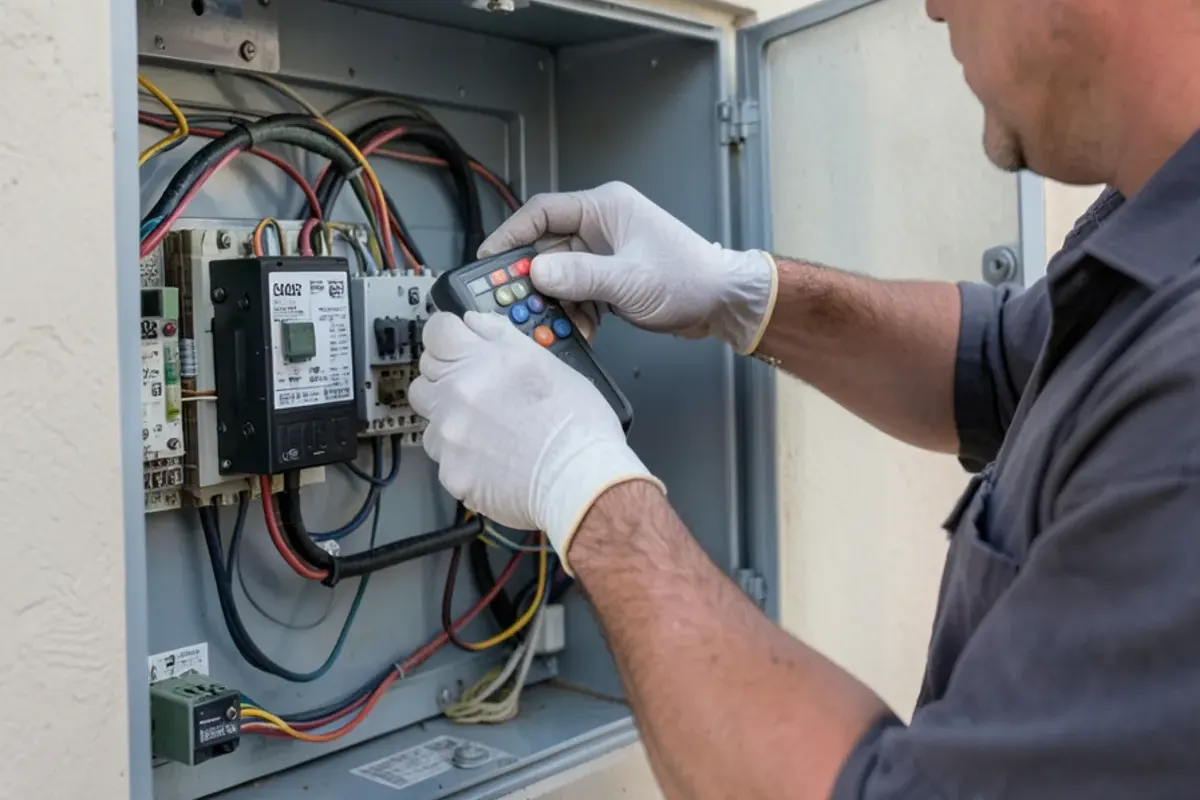
Is the Equipment Right for the Cold?
Sometimes the unit is fine and the match is wrong. An older heat pump will rely on backup heat more than a modern cold-climate model. ENERGY STAR says certified cold climate heat pumps are tested down to 5°F, and it recommends a Manual J size check, a load calculation that matches the system to the house. NOAA engineering data puts Albuquerque's 99 percent design temperature at 19°F, so a healthy modern unit seldom meets a night near that test point. Older equipment and East Mountain homes have less margin.
If your unit is old and fails again, consider what heat pump installation would look like against another round of repairs. Federal minimums now stand at 14.3 SEER2 and 7.5 HSPF2 for split heat pumps, per DOE. HSPF2 is the seasonal heating efficiency rating.
Trade-Offs in Fixing a Frozen Heat Pump
The right fix depends on what you are willing to pay for, now and over the next few winters.
- Backup heat during defrost. Many systems run auxiliary heat during defrost so the vents do not blow cold. That protects comfort and uses energy. A Pacific Northwest National Laboratory report on DOE cold climate units says defrost energy can be significant when auxiliary heat is used.
- Emergency heat or a cold house. Emergency heat is a fair bridge for a day or two, and a poor way to spend a winter. Set a limit on how long you will run it before the repair gets done.
- Raising the unit. A stand keeps it above snow and ice. It also means line and electrical changes, and PNNL's guide notes wall-mounted units can vibrate, so check for that if you hang one.
- Hoods and splash guards. A guard can stop canale drip from landing on the cabinet. Put it too close and you choke the airflow the coil needs, so follow the manual's clearances.
- Defrost board or new system. A failed board on a sound unit is a repair. If the same old unit also has a leak or a tired compressor, price a replacement beside it.
Clear It, Diagnose It, Prevent It
Let normal frost melt by itself, and shut the system down when ice takes over. Most faults come down to the defrost controls, airflow, charge or roof water, and a test tells us which.
Book heat pump repair in the South Valley or elsewhere in the metro at (209) 563-1270. If the house is cold after hours, our emergency HVAC line answers around the clock.
Areas we serve
Common questions
How long should a heat pump defrost cycle last?
Usually a few minutes, though the length varies by model and conditions. Expect the fan to pause and possibly some steam. If the unit stays iced after an hour or so of normal running, or goes into defrost again and again without clearing, shut it off and call.
Can I pour hot water on a frozen heat pump?
No. Hot water can stress the coil, then refreeze around the base and add to the problem. Chipping at the ice is worse, because it can damage the fins or a line. Shut the system off, use backup heat and have the cause tested.
Should I cover my heat pump in winter?
Never with a wrap or tarp. The unit runs all winter and needs open airflow, so a full cover can starve it and trap moisture. PNNL's guide does say a cover can protect an outdoor unit from falling snow and ice, which means a raised hood with open sides, set to the manual's clearances. In the South Valley, moving roof runoff away from the cabinet often does more good.
Sources
- ENERGY STAR: Air Source Heat Pumps
- ENERGY STAR: HVAC Maintenance Checklist
- EPA: Frequent Questions on the Phasedown of Hydrofluorocarbons
- National Weather Service Albuquerque
- National Weather Service Albuquerque: Fall Freeze Feature
- NOAA NCEI, Engineering Weather Data: Albuquerque
- PNNL Building America Solution Center, Ductless Mini-Split Heat Pumps
- Pacific Northwest National Laboratory: Performance Results from DOE Cold Climate Heat Pump field work (PNNL-37127)
Rather have someone look at it?
Call any hour. You get a straight answer, a free written estimate and the price before the work starts.
- NM CID License #413436
- 24 Google reviews
- Led by Dominic Montoya, over 20 years in the trade
- Free written estimates
Red Wrench Company, 5635 Paradise Blvd NW, Albuquerque, NM 87114, (209) 563-1270