

Repair or Replace: When an Old AC Is Not Worth Fixing
The failed part, the age of the system and the refrigerant it uses decide this more than the size of one repair bill.
- NM CID License #413436
- 24 Google reviews
- Led by Dominic Montoya, over 20 years in the trade
- Free written estimates
By Dominic Montoya, Owner of Red Wrench Company. Published , updated .
The repair or replace AC question comes down to what failed, how old the system is, and what refrigerant it uses. Repair a sound system with one failed part. Start pricing replacement when a major component fails on a system past about 15 years, or when an older R-22 unit develops a leak.
How Long Should an Air Conditioner Last?
The U.S. Department of Energy lists a life span of 15 to 20 years for central air. ENERGY STAR suggests having equipment evaluated by a professional once it is more than 10 years old or stops keeping the house comfortable. So age 10 is a checkup, and age 15 is a planning date.
Albuquerque summers are hard on the back half of that range. National Weather Service Albuquerque recorded 551 cooling degree days in August 2026 against a normal of 367, which means long run hours on equipment that is already tired. Many homes here date to the 1980s or earlier, and some of their original ductwork and electrical work has aged along with the equipment.
Repair or Replace AC: What Failed Decides It
The part that failed tells you more than the price tag.
| What failed | System under about 10 years | System over about 15 years |
|---|---|---|
| Capacitor or contactor | Repair | Repair, and check why it failed |
| Condenser fan motor | Repair | Usually repair |
| Blower motor or control | Repair | Repair if the rest is sound |
| Drain clog or float switch | Repair | Repair |
| Small accessible refrigerant leak | Repair the leak, then recharge | Depends on refrigerant and where the leak is |
| Evaporator coil leak | Check coverage, then repair | Price replacement alongside it |
| Compressor | Check coverage, then decide | Lean toward replacement |
Warranty coverage varies by manufacturer and registration, so read your own paperwork before you decide. Any repair we quote comes with a written price before work starts.
What If Your System Still Runs on R-22?
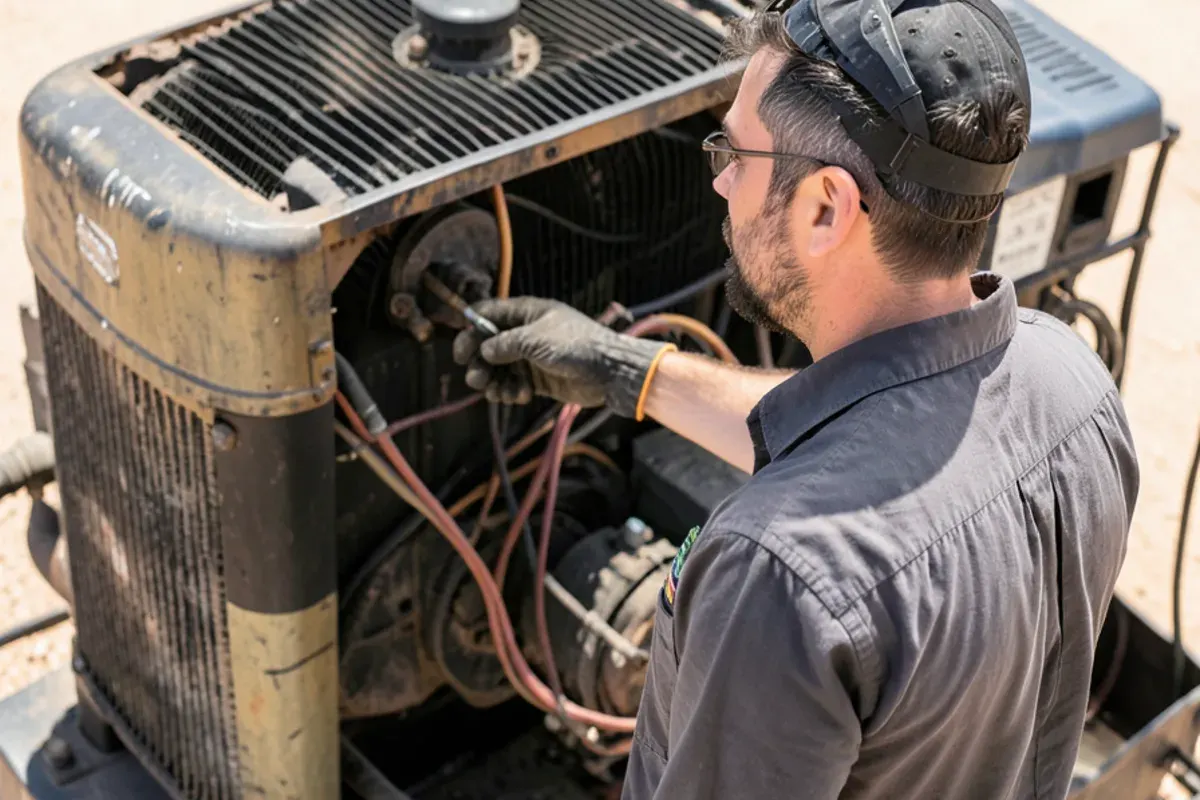
R-22 is the refrigerant in many older air conditioners, and new supply has ended. The EPA's phaseout table shows no production or import of HCFC-22 after 2020. Existing equipment can keep running, and the EPA notes that some uses continue for servicing, so you do not have to rip out a working unit.
A leak changes things, though. You are paying to repair an aging system, then paying for a refrigerant that is only available from existing or recovered supply. On an R-22 unit with a leak in the coil, we price replacement alongside the repair.
Newer refrigerants matter as well. Under EPA's 2023 Technology Transitions rule, new residential air conditioning systems moved to a lower global warming potential limit, while existing systems may be serviced and repaired throughout their useful life. EPA issued a further final rule in May 2026 and says that its earlier fact sheet has not been updated, so check the agency's current sector table for specifics. That table shows a limit of 700 for new residential and light commercial systems from January 1, 2025, and a footnote exempts systems whose specified components were all made or imported before that date.
The practical point for homeowners is matched equipment. A new outdoor unit generally has to be paired correctly with the indoor coil. Swapping only the outdoor half of a very old system is rarely the bargain it looks like. Ask for an AHRI matched-system reference, which confirms the indoor and outdoor pieces were rated as a set.
How Do You Compare the Real Cost?
Put the two options on paper, side by side. Look past this year's repair.
- Repair price today, plus likely repairs over the next few years
- Age of the coil, compressor and blower compared with the part being fixed
- Replacement price from a written quote, including any duct or electrical work
- Efficiency gain over your current system
- Rebates that apply, confirmed with the utility
As a third-party reference, RealCostIQ's 2026 estimate puts full HVAC replacement in Albuquerque at $7,536 typical, with most projects from $3,589 to $11,483. That is a non-government estimate and not our quote. AC-only work can fall well outside that figure, so get a written local quote.
Today's minimums are a lot better than what most older units were built to. In the Southwest region, split central AC needs at least 14.3 SEER2 under 45,000 BTU per hour and 13.8 SEER2 at 45,000 and up, under DOE regional standards. SEER2 is simply the current seasonal efficiency rating. PNM has offered $250 for early replacement of SEER 13 or lower equipment, but amounts conflict by source, so verify with PNM. The federal 25C tax credit ended for equipment placed in service after December 31, 2025, so do not build that into your numbers.
Fix the Ducts Before You Blame the Box
Weak cooling is not always the equipment's fault. ENERGY STAR advises sealing major air leaks and the duct system before buying new HVAC, saying these are sometimes the real source of the problem. It also says improper installation can cut efficiency by up to 30 percent.
If you are replacing anyway, have the ducts inspected first. A duct repair may be the difference between a new system that performs and one that disappoints.

What We Tell Customers About Old Systems
- Do not replace a working system over one capacitor. That is a small repair, whatever the age.
- Do not keep adding refrigerant. Refrigerant circulates in a sealed loop. If it needs more, there is a leak.
- Plan before the failure. Choosing in April beats choosing in a heat wave.
- Ask for both numbers. On a major failure, we can write up the repair and the AC replacement on the same visit, so that you are comparing real prices.
- Get a load calculation. New equipment should be sized by Manual J, not by the old unit's label.
Rural and foothill homes have one more thing to weigh. In Placitas, access and long drives can make repeat breakdowns more painful, so a shaky system may be worth replacing on your own schedule. If the failure is small and the unit is sound, simple AC repair remains the right call.
The Honest Case Against Each Option
Each path has a real downside, and a fair estimate should admit it.
Against repairing. You put money into equipment that keeps its old efficiency, and the next failure may be a different part of the same tired system. On an R-22 unit, each leak also means buying from a shrinking supply.
Against replacing. It is the largest bill on the table, and a new system will not fix undersized ducts or a leaky return. The job can also grow once the ducts, the electrical service or the line set get a close look. A leaking coil on a five-year-old system rarely justifies it.
Against waiting. Nursing an old system until it dies feels thrifty, and for some owners it is. The cost is losing control of the date, because a July failure leaves fewer install slots and less time to compare quotes.
Moving soon changes the math more than any rule. If you expect to leave within a few years, a repair that keeps the system cooling may be the better buy.
The Decision in Short
Repair small failures on sound equipment. Compare both options when a compressor or coil fails on a system past about 15 years, and take R-22 seriously when a leak appears. Whatever you do, get the price in writing, check the ducts and decide on your schedule rather than during the hottest week of the year.
Areas we serve
Common questions
Is it worth replacing an AC compressor on a 15-year-old unit?
Usually not, though it depends on the rest of the system. The new compressor sits on an old coil, fan and controls, each of which may fail next. A compressor swap also may not fix why the first one failed. Get the repair and replacement prices written up together, check any coverage on the original parts, and weigh them against how long you plan to stay.
Can I still get an R-22 air conditioner repaired?
Yes. Existing R-22 equipment can still be serviced, and the EPA notes that some uses continue for servicing refrigeration and air conditioning equipment. New production and import of R-22 ended in 2020, though, so supply comes from existing or recovered stock. Small repairs that do not involve refrigerant are often still worthwhile on these systems.
Does the 5,000 rule work for an AC repair decision?
It works as a rough screen and nothing more. The rule multiplies the system's age by the repair price, and a result above 5,000 suggests replacement. It is a trade rule of thumb with no agency behind it. It ignores refrigerant type, duct condition and how long you plan to stay, which often matter more in an older Albuquerque home. Use it to start the conversation, then compare two written prices.
Sources
- ENERGY STAR, Heating and Cooling
- U.S. Department of Energy, Energy Saver 101: Home Cooling
- U.S. EPA, Phaseout of Class II Ozone-Depleting Substances
- U.S. EPA, Technology Transitions Program fact sheet (2023 rule; EPA notes it predates the May 2026 rule)
- U.S. EPA, Technology Transitions HFC Restrictions by Sector
- AHRI Directory of Certified Product Performance
Rather have someone look at it?
Call any hour. You get a straight answer, a free written estimate and the price before the work starts.
- NM CID License #413436
- 24 Google reviews
- Led by Dominic Montoya, over 20 years in the trade
- Free written estimates
Red Wrench Company, 5635 Paradise Blvd NW, Albuquerque, NM 87114, (209) 563-1270